Perspective
A Microscopic View of One of Our Kombucha SCOBY's Grown on Sencha (green) Tea
Photo by Ben Wolfe
To increase our understanding we need to take the time to take a closer look.
-Kevin

A Microscopic View of One of Our Kombucha SCOBY's Grown on Sencha (green) Tea
Photo by Ben Wolfe
To increase our understanding we need to take the time to take a closer look.
-Kevin

A beautiful Sunday morning in May. The blossoms arrived in a woven basket hanging off the arm of Jeffrey Stoneberger who arrived at The Shop with his usually flurry of activity. Out of the basket the blossoms swayed on branches, ethereal and cloud like, in a shifting range of pink to white, petals drifting down to the table top.
What to do with them? Kombucha for sure.
What else? How does one capture the delicate in its profound and fleeting moment?
The Japanese have a tradition of preserving cherry blossoms in salt. Sakura no shiozuke.
The technique is a bit of a departure for us. At the shop we create acids. This called for adding one: vinegar. As it happened, Jeffrey also brought with him an exquisite pear-sake vinegar that he had crafted with all the love and care that characterizes his work. The project seemed fated.
The next morning, while plucking blossoms for an infusion we would ferment with a kombucha SCOBY, I put aside many of the tight pink buds and the vibrant and sturdy newly opened blossoms. I salted and pressed them for three days. Such an incongruous treatment of these delicate structures. On the third day, I drained off the modicum of brine that had developed and mixed the blossoms with a small amount of the pear-sake vinegar. They sat in the fridge for a week. I then laid them out to dry on a rack for a day.
A moment of textural give. A hint of spring. Floral then gone. A touch of acid on the tongue.
The salinity lingers.
I repacked them in salt for the future.
Two weeks later I was bottling cherry blossom kombucha. I carefully placed the blossoms, that had fermented in the kombucha, into the bottles with chopsticks. Across from me sat two of my favorite people to come into The Shop, Kyle and Katina Connaughton, who had come in for a visit and were doing a tasting of our tsukemono. Kyle was scheduled to cook at a benefit in New York for the Edible School Yard. He would be cooking with a number of other notable chefs in an effort to raise money so that the city's children may have a garden in their schools that they could sow and reap from during some pretty formative years. Establishing connection. Eighteen years ago, when Alice Waters launched the Edible School Yard Project, the flagship garden was to be located at King Middle School in Berkeley. We had just left the farm and were living with Alex's parents. We had no jobs and our son Keiran was 4 months in utero. Both Alex and I applied for the position of project manager for the fledgling garden. Neither one of us got an interview. Needless to say it has grown way beyond any scope and vision I may have had as a scared and unsettled twenty-five year old. All for the best, as it turns out we had other things to do. Kyle wanted to bring some tsukemono to New York with him. He asked if I had any sakura no shiozuke to give up. I did, and the following week he used them to garnish a sashimi dish, on the other side of the country, for a very worthy cause.
This here is the sweet spot. To make a tiny gesture to preserve a moment in time, all that made it possible and all its possibilities.
300 grams Cherry Blossoms
3 tbsp salt
3 tbsp vinegar
-Kevin
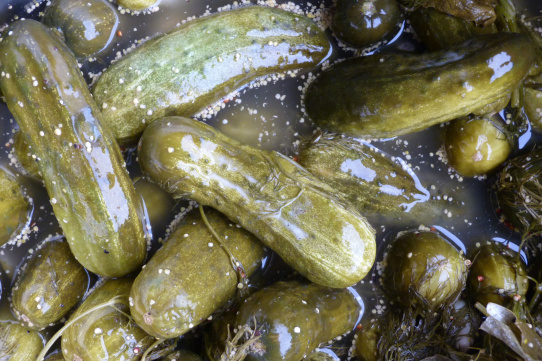
It is this time of year that we finally become a pickle shop. Without fail, folks will wander into The Shop from January through June, stare blankly at the retail cooler for several minutes, then look up at us and ask, "Do you have any pickles?" For the first few years, it was all we could do to keep from bursting out laughing. They were, of course, looking at a cooler full of pickles. But we know, as you surely know, that they are looking for cucumbers. Cucumis sativus or perhaps Cucumis anguria. From the family Cucurbitaceae. Squash, melons, and gourds.
By far the most fermented cucurbit in the United States is the cucumber. Fermented in a salt water brine, usually with dill and garlic and a variety of spices, it's ubiquitous. The pickled cucumber came to this country with immigrants hailing from Northern Europe through its far Eastern reaches. They are known as Pickles. They are Pickles.
Besides cucumbers, we see a variety of melons and gourds fermented throughout Asia. What we don't tend to see is Winter Squash. Cucurbita Maxima (think buttercups, kabochas, hubbards) and Curcurbita Moschata (think butternuts, and peachy skinned pumpkins). They challenge one of The Shop's basic rules of thumb: is this vegetable pleasant to eat raw? Winter squashes challenge this rule with total grace. They are by their very nature storage vegetables. Crazy hard shell. Dense flesh. Winter sustenance. So why bother? In our mind's eye when we think of these sugar powerhouses it is of familiar comfort foods—pumpkin pie, butternut squash soup, a kabocha puree. They can be some pretty serious, stick to your ribs, sweet mush. We say that with complete respect, this sweet mush is amazing, and along with scarves and the sound of rain on skylights, it might be our favorite winter reality. And maybe because they are some of our favorite foods, we are drawn to explore them deeper. Often people think that Winter Squash tastes like pumpkin pie mix. What if we take away the cinnamon and the caramelized creaminess and tried to approach them from a different angle? With texture. Cooked, but not. Crunch without the back of your throat starchiness. A whole palette of amber, umber, ochre. Preservation not borne of necessity but of pure curiosity. Luxury.

Made with a Musquee de Provence Pumpkin. When you crack them open they look like giant papayas. Do not attempt with your common jack-o-lantern, they are far too dry and flavorless. A crunchy and juicy 2mm julienne works well. They are not at all fibrous. Brine the color and body of orange juice. The scallions for color and crunch. The Espelettes add a well balanced warmth.

Fairytale pumpkin. Enormous pleated flesh colored things that decorate the front of our shop all winter. We set the 1/4-inch thick slices into our favorite barley miso in January 2012. At this point, some eighteen months later, they are great. Part pumpkin, part miso with a fabulous texture.
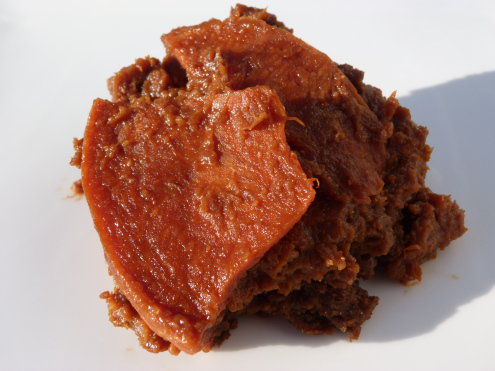
Again we used the fairytale here. We adore this pickle. The color has remained rich and vibrant. Though thoroughly fermented, there is still a textural snap and crunch that gives you the raw experience. The floral components of the koji and the booziness of sake pair so well with the natural sweetness of the pumpkin.

Standard and reliable. The squash will retain its texture better if each piece is cut with a bit of the rind side intact. This kimchi is one of our perennial fall favorites. We have paired the butternut with various mushrooms and even huitlacoche, always with great results. Note: Shiitakes will often cause accelerated textural breakdown in ferments, so be prepared for things to be a bit softer if you choose to work with them.

Totally seductive, effervescent butterscotch. Pumpkin-Rooibos Kombucha is a warm caramel union of rich, earthy, red Rooibos tea and deep golden Fairytale pumpkin. We join the bright southern light of the high desert of South Africa with the autumnal glow of Northern California.1 It's a delicious beverage.
We'll venture to say that the exploration of winter squashes has been and is one of the most gratifying projects of the shop. Beautiful. Mind-Expansive. Conversation-Forwarding. Unexpected.
-Kevin & Alex
1-Victoria K Fort

Cherry Blossom Kombucha
Recently, on a Saturday morning, as I was finishing setting up the stand at the Berkeley Farmers Market, a customer asked me an extremely complex question. The early shoppers tend to be our most regular ones—eager to get first pick at whatever new concoction we might have—and indeed this shopper is what I would consider a great customer. I see her most every week and she purchases an average of 3-4 items: almost always a Nutra Kraut (our super blue-green algae kraut), a seasonal kimchi for her partner (she doesn't do spicy), and usually a Kombucha, most often something with ginger or turmeric. She returns her bottles—although definitely not cleaned—and is generally pleasant.
So, as she's perusing her options on the Kombucha stand (generally first thing in the morning I have about 10 options) she asks in the same tone as she might inquire what time it is, "What do cherry blossoms do?" Cherry Blossom Kombucha was an option that morning. It had never been an option previously and wouldn't again for quite some time. And even then, chances are it wouldn't be as perfect as those two dozen bottle I had with me that morning.
I am presented with an interesting challenge when someone asks a question that I process as ludicrous. Yes, I knew she wanted a direct response as to the precise positive action cherry blossoms would perform within her body: some particular nutrient or enzyme they were particularly well endowed with, some reason why this $6 investment would be sensible. But damn, I was so unable to answer. If I could provide the answer she was searching for, even speak in the same language for a few moments, I could be released from the awkward exchange sooner. But I can't do it; it is the wrong question. Not only does it not make sense, I think the sentiment behind it is flawed. "What do they do?" I responded right back at her, "They're cherry blossoms."
"No, you know, like what are they good for?" she clarified, slightly annoyed that we seemed not to be communicating. "You know...like turmeric is good for inflammation...."

Cherry Blossom SCOBY
Yes, I am a true believer in the food-as-medicine lifestyle. Yes, particular foods are particularly healing for specific conditions. I have dedicated my entire adult life to the study of nourishment. But I believe the inability to view the whole as more than the sum of its parts has become a pathological condition for many in this community, and it is not making anyone healthier.
One weekend this May, we were fortunate enough to receive an outrageous amount of luscious, pink, fragrant cherry blossoms. The next morning we made a concentrated infusion, and introduced—quite possibly the first date for them—a Kombucha SCOBY. Over the next couple weeks, the petals intertwined themselves within that zoogleal mat, gurgling happily, creating in their union what I would describe as the most perfect of fairy garments. At bottling, this brew was mixed with some raw local honey and the bottles, each one with cherry petals chopsticked in, sat in our cave over two more weeks.
You really never know until you open the bottle. You could have done everything to this point "right" and still it could really suck. But from the smell you know. And the smell of the cherry blossom kombucha, bubbles dancing under the nose, encouraged some pretty large smiles. Indeed, sometimes the smell can hold such subtle beauty that you feel like you are being let in on the most fantastic of secrets. The delicate dance of the blossoms as they floated to the surface after the top was released was pure joy and delight to behold. The fairytale dress SCOBY had produced a fairytale flower champagne.
What do cherry blossoms do? I've thought about that question a lot over the last couple of months. Nothing and everything. I believe that resonance holds more power than any specific index of values ever will. Story and alchemy surround you. Pay deep attention to your food and it will feed you deeply.
-Alex
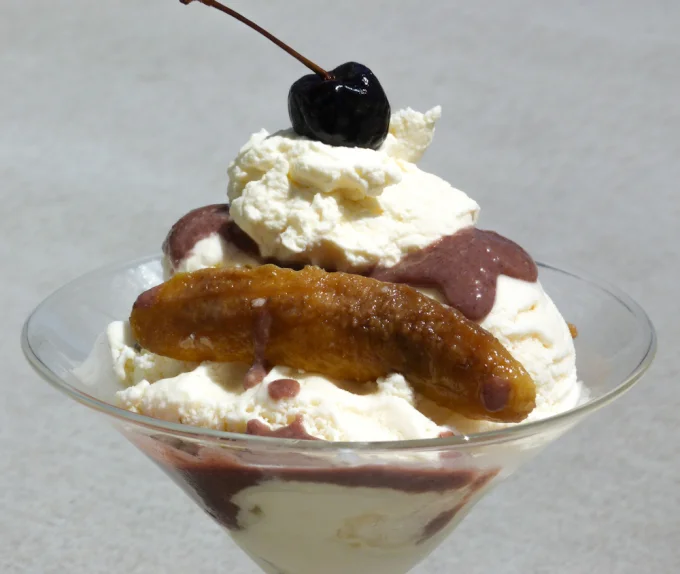
Tsukemono Sundae
Kasu Ice Cream & Umeshu Ice Cream
Shiro Misozuke Banana
Koji Fermented Adzuki Bean "Hot Fudge"
Nuka Cultured Whipped Cream
Umeshu Cherry
There is a word that all of us who make food for people use everyday, when we set plates on tables or slip jars into hands. Enjoy.
Enjoy.
A conjuring of intent. A prayer. A desire, perhaps, that the work we've created will be appreciated. Deeply.
Our work is understood to be healthy. By that I mean that there are measurable health benefits to consuming our products. Mainly this comes in the form of bacteria. They keep our engine running. They are our engine running.
We fully embraced this from the beginning. The words probiotic bacteria can be found on our label along with Restore & Revitalize and an FDA disclaimer. We know. We understand. People want, people need. We deliver.
I don't think much about the health benefits anymore. Not in any direct or overt way. They are, for certain, a thread that weaves through all of our work. In so much as they spring from that which provides the very action of the work, their importance cannot be overstated. It is foundational. A given.
What we seek is creative collaboration with these fundamental forces, to give rise to something delicious.
Occasionally when we are reminded, we are caught a little off guard, left a little speechless. Example: At the farmers market a while back, Alex slid a jar of sauerkraut into the hands of a customer and said pleasantly, "Enjoy," to which he gruffly replied, "I don't eat this because I enjoy it, I eat it because it's good for me. It's not ice cream."
Well, he does have a point there. Pickles are not ice cream.
-Kevin

It's all about the timing. The garlic has to be fresh dug. Cloved but not cured. The skins are thick and need to be cut away with a paring knife to get to the tender kernel. From late May through early June we dedicate a lot of time at The Shop to Garlic. The young tender cloves will be buried in our favorite two-year barley miso and left to age, in the jar they will be sold in, for one year in the cave. People often ask me what my favorite product is that we make. I always dismiss this question with the usual, "What? Please! You are asking me to choose amongst my children." But this—June garlic fermented one year in barley miso—this is it. My favorite child.
Over the year the garlic ferments through. Umami rich, they are salty and sweet and pure garlic without the heat and volatiles. I can pop them like candy. They age beautifully. We have vintages going back to 2009 and the depth of flavor seems endless. But the miso itself is the reward for the patient. Garlic has permeated; so much so that you'd be hard pressed to cook this flavor into miso. Delicious.
-Kevin

It's been a haul. In the beginning, we set up shop in our small ground floor apartment. There were years of nights spent up so late. So many nights when the baby wouldn’t go down, or stay down, and at two or three or more in the morning under the harsh light of florescence we'd be in our kitchen, with the babe in the backpack snoozing—or more likely not—and there would still be so much more clean up ahead and I would have to leave in a couple of hours to shelve catalog items for retail consumption at a Smith & Hawken garden store. I agree that normally we aren’t able to recall painful moments in too clear of detail as to save us from the trauma of having to relive the episode. Though I have to say, I remember the kitchen so well. The cupboards were this plaid of gray, red, and orange blocks with thin yellow stripes. The linoleum tiles of the kitchen floor were Etch-A-Sketch gray from centuries of traffic buildup. The kitchen was about 90 square feet. It housed the cabinets mentioned above, that only extended far enough along one wall to offer a single basin stainless sink. A sink which, it should be said, was placed into a countertop of yellow and brown leopard print Formica. It also contained a mustard-colored stove with a matching hood, of course. The refrigerator was white and modern, but lacked a water and crushed ice dispenser. We had a small white table from Scandinavian Designs with a hinged leaf, should we be expecting company, and four wooden chairs with rattan seats. It was also partial home to a huge industrial-grade stainless steel reach-in refrigerator, the rest of which extended into the entryway and blocked the front door from opening entirely. A 4' x 2' stainless steel Metro shelving unit sat in front of the kitchen's only window and supported, above the ground (in accordance with health codes floating in a sea of violations), five-gallon stoneware crocks filled with Brassicas in full ferment. There was another Metro shelf perched on the wall between the big fridge and a doorway. The doorway encompassed a step up to the living room which was floored with parquet and had a very, very low ceiling. The living room housed refrigerator number three. This one no longer functioned and was not plugged in. It was white and had a hole in its side where apparently a bullet had entered never to return. Under the bullet hole there were streaks of rust, looking like blood, running through the letters W S B which were rendered in fat blue marker ink in the style which everyone recognizes as the Gang Font. West Side Berkeley is an appropriately named outfit that contains some of the most ambitious taggers of all the local social clubs. Their initials are scribbled liberally across the town's nooks and crannies. Inside the fridge I had rigged up an incubator switch to a light bulb which kept the compartment within the perfect 30-degree variance of 74 to 104 degrees. We used it to incubate white sushi rice which had been inoculated with the mold spores of Aspergillus oryzae, for koji, which we then set free in a vat of salted soybean mash to make miso. We used it to inoculate soybeans themselves with Bacillus subtilis natto or Rhizopus oligosporus for natto and tempeh respectively. Next to the gangsta fridge was a wooden warehouse pallet which was average in size and on the ground supporting vessels full of fermentation. On the other side was the koji table, where the koji was processed once incubation was complete. There was so much controlled rot occurring that, with the nearly palpable energy of transformation, there seemed to always be a buzz, felt above the hum of the fridges and the drone of the florescent bulbs above. Felt even above the buzz of insufficient stereophonic that Bob Edwards' voice echoed out of, carried on the first broadcast out from D.C., earlier than most truck drivers would catch. We were mostly slumped over ourselves by this time in the evening. That is except, of course, for the sleepless young one. I wonder if the energy of the house, due to the alchemical atmosphere, caused the babe to be mostly awake unless in motion for the first two years of his life. Or perhaps it was us clanging around every night until the witching hour. So we would be there amongst all that in the kitchen and the boy would be on my back in the Tough Traveler pack. I recall feeling stunned, like in the headlights, with all of this around me. There I was sifting around in drifts of shredded cabbage on the linoleum, the light gleaming off the stainless all around, and it's later then I can feel, and I’m madly wiping at the deposits of crushed Cruciferae in the crevice of the fold down leaf of the white table. And you know what? NPR can be so disconcerting at this time, feeling like this, with Bob Edwards saying, “Good morning—NATO has launched air-strikes in Kosovo—I’m Bob Edwards and this is Morning Edition,” and then the music comes up, and B.J. Leiderman gives us a rise and shine.
-Kevin
It's not mold, it's yeast, commonly called Kahm, which is a sort of catch-all term for a variety of yeasts that can form a film, or pellicle, on top of ferments.1 It's harmless. No one is going to get hurt here. It's alright, no need to panic. It's incredibly common. It can, however, negatively affect taste. Our lid system prevents the yeast from coming in contact with the ferment. You can just scrape it off. Covering your ferment with cheesecloth makes it easier to remove.


Change the form. Vary the use. Expand your notions.

Beet & Fennel Brine
Put it in a Shaker - Sprinkle on Soups - Stir into Stews - Dry Rub Meat - Top your Popcorn - Lime Pickle Hollandaise
Spice up your Marinade - Sauerkraut Leather - Rim a Cocktail - Add it to a Dressing - Toast on a Bun - Season your Fries

Fermented Chili Powder & Flakes
Make a Simple Syrup - Replace Salt - Add to Pasta Dough - Dust Chocolate - Flavor Sauces - Lick off Fingers
Season your Burger - Make a Dip - Add Complexity to Chili - Keep by the Grill - Instant Broth
Spice up Mayonnaise - Whisk into Batter - Coat your Crackers & Chips - Add to Pickling Spices - Sprinkle on Deviled Eggs

Lime Pickle Powder
Whip into Butter - Toss into Salads - Sprinkle on your Pizza - Add to Guacamole - Add to Batters - Season Nuts
-Kevin

Ume On The Tree
Every year in early June, after the last of the spring rains have fallen and the fruit of Prunus mume have begun to blush, we head over to the North side of town where a long time customer has a tree. Ume, the fruit of the Prunus mume tree, is commonly referred to as a plum. However once you hold the fruit in your hand and feel the soft fuzz and take in the strong sweet fragrance you might sense that this is much more closely related to an apricot, which it is.
The tree is small and sturdy. It is planted up against a backyard tool shed and with one of us on the shed roof and one on the ground we strip the tree of fruit, in one short hour filling two 5 gallon buckets.
Back at the Shop the fruit is divided into those that are blushing and those that are solid green. The blushing fruit is salted and used for Umeboshi.

Salted Blushing Ume
The green are steeped in Mugi Shochu, a distilled alcohol made from barley, and mixed with sugar to create Umeshu. This alcohol maceration process will take the better part of a year.

Mugi Umeshu
The salted Ume are then packed into the stoneware crocks that we used to ferment our sauerkraut in, years and years ago. They are impractical for the volume we do now but we have kept a few around for small projects. We press the Ume by placing a plate over the top and weigh it down with a bag full of pebbles. We allow it to sit for several weeks to create a brine.

Ume Brine
After a few weeks of pressing the Ume has released some liquid and formed a brine.We then drain the brine, setting it aside for later, and lay the Ume out onto racks to dry for about two weeks.

Drying Ume
We add Red Shiso (Perilla frutescens) to the Ume brine. This is what gives the Ume its color.

Shiso in Ume Brine
After drying, we pack the Ume back into a crock and add the Shiso infused Brine. They will stay in this crock under pressure for several months.
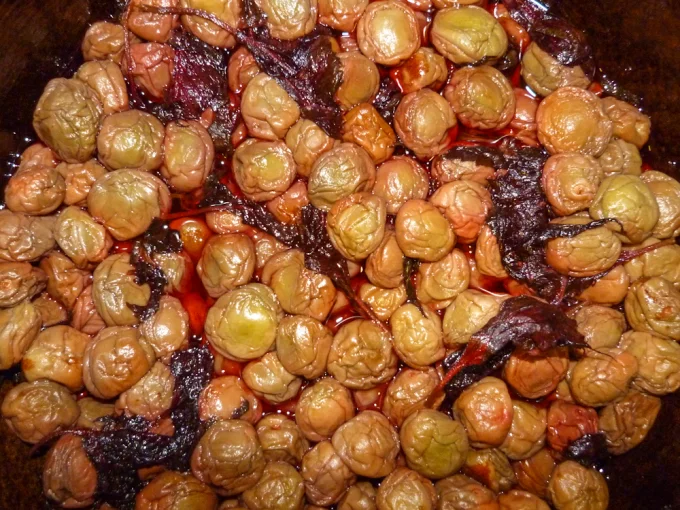
Ume Packed with Shiso & Brine
Usually we allow our Ume to ferment under weight for about six months. After that time, we take them out and age them in jars. We have vintages going back to 2008.

So here's the question. Why are we not doing this with other stone fruit? On our list to try in up and coming years: Apricots, Peaches, Nectarines, Pluots, Plums, and Cherries
-Kevin

Some customers are confused when they come in. "Where's the shop?"
When we say Shop we mean Workshop.
Sure you can buy shit here,
But this is where we get it done.
-Kevin
Kasu. Sake kasu. Sake Lees. Dregs.
Tapping into waste streams and re-purposing for deliciousness.
After a tank of sake has run the course of its fermentation—anywhere from 18 to 32 days—what remains is a white mixture of sake, rice solids, and yeast. This mixture, known as the moromi, is pressed to separate the sake from the suspended solids. There are several methods of pressing the sake out, leaving compressed rice solids, or lees, behind. This is Kasu.
Larger sake producers extract the sake from the lees by machine and the kasu comes out in thin dry sheets called itakasu. Smaller producers may press their sake by hand using a wooden box called a fune, which has a lid that gets cranked down on the sake mash, or moromi, which has been placed in small canvas bags. This method will yield a kasu that is moist and chunky called teshibon or namakasu.

Sakekasu
Kasuzuke or vegetables pickled in kasu, are said to have originated in the Kansai region of Japan as early as twelve hundred years ago. The first vegetables known to be fermented in kasu were white melon and were named shiru-kasu-zuke or Nara-zuke. Later, the technique would used with cucumbers, eggplants, and uri or bitter melon. It was produced primarily by Buddhist monks and used by Samurai for sustenance in wartime and winter. During the Edo period of the 17th century, sake producers promoted the use of kasu widely. Not long after, kasuzuke would become a mainstay in the ever expanding repertoire of Japanese tsukemono.
We are fortunate to be located just blocks from Takara Sake one of the largest producers of sake in the United States. We have a long standing relationship with Takara, and after each pressing of their Certified Organic Ginjo Grade Junmai Nama Sake, they put aside about 150 lbs of kasu for us. The kasu has been pressed mostly dry at the factory and has a slightly sticky putty-like texture. Kasu is stored in the refrigerator and the cold makes it stiff and a little unyielding. We allow it warm in a bowl on the counter for the day and as it warms it becomes much more pliable and easy to work with. We knead salt and sugar into it until the dry sheets form a thick sticky paste. We then bury vegetables that have been salt pressed for two days into the paste . The vegetables ferment from three months up to a year or more. The result is a delightful and unique pickle with a distinct sake taste, quite unlike anything found in Western pickling traditions.
Typically we intend to ferment our kasuzuke for 12 months. With this in mind we have found that a ratio of 10:3:1 kasu:sugar:salt, works well for us. Those ratios will be adjusted down for shorter term ferments of vegetables that are more tender. One of our favorite kasu pickles is burdock.

Burdock in kasu
Burdock. Arctium lappa. Gobo in Japan. It is the long tap root of a thistle. Dark and woody, it is deep in earthy overtones and slightly sweet. We wash the burdock well and press it at 6% salt for two days. The burdock is spiraled into a vessel and layered between the kasu-sugar-salt mixture. In the initial weeks of fermentation there will be a fair amount of carbon dioxide released and pockets will appear. To combat this, and insure optimal kasu to burdock contact, we weigh the ferment down.
Our burdock ferments for 12-18 months. One of our longer ferments, it needs that duration for the dense, sturdy root to ferment clean through. It is a testament to the hardy strength of burdock that after a full fermentation it retains most of its flavor and texture. Though the sake and koji permeate, it is still astonishingly earthy and woody.
For years we enjoyed this pickle sliced thinly on a bias. Wood chips, I called them. Wonderful, flavorful wood chips. Then I introduced it to the microplane. Burdock kasuzuke loves the microplane. A melt on your tongue snow of sweet earth.

Burdock kasuzuke, Fresh Hijiki, Scallion

Gingko Nut
Kasuzuke
Misozuke
These pickled gingko nuts were initially inspired by a visit from Mike Ryan, the Chef de Cuisine at Elements, in Princeton New Jersey. Mike is such an amazing, creative guy. He and Chef Scott Anderson are doing some of the most exciting work with fermentation in fine dining today. They are the first restaurant that I have seen to incorporate kombucha into their dishes, rather than it being relegated to beverage status. They are creating hard cheeses out of almonds, fermenting them with Rejuvelac, and hardening them with transglutaminase. They are aging pork loin coated in uni paste. Really cool shit. Mike came into The Shop one afternoon and we hung out for a while tasting ferments and trading ideas. We were trying various misozuke, turnips, June garlic, and a three-year fermented pumpkin. Mike proposed fermenting chestnuts. I countered with gingko nuts. A couple of days later I started these and he started chestnuts.
I purchased some fresh gingko nuts and layered one batch in a two-year barley miso. The other batch I layered in a sake kasu that had burdock fermenting in it for 18 months. This kasu is beautiful. There is a heady aroma of sake, koji, and rich geosmin from the burdock. The kasu, after having a vegetable fermenting in it for that duration, is teeming with enhanced microbial activity. It is a superior product, ideal for short term ferments, especially proteins. I found that after two months both batches were quite delightful. The outer layer of the nut still had some resistance and density, with a slight chalkiness, while the centers had become a wonderfully flavored jelly. An explosion of flavor and texture in the mouth. Last I heard, Mike's chestnuts were still fermenting. I imagine they may take a year or more.
I know that this is going to lead to a whole miso & kasu fermented nut program at The Shop. Stay tuned.
-Kevin
When our 16-year-old son came home from spending spring break on a class trip to China, he—of course—brought back pickles. A barely fermented chili paste, strong, garlicky, and salty. And a jar of pickled turnips. The chili paste was pretty unexciting but the turnips were to die for. They were hardly brined, with a nice heat from chili and an amazing chewy texture. We immediately wanted to try to replicate it.

We decided we would use daikon, because we had a bunch around the shop, and because its size lent itself to a long, noodle-like julienne. We laid them out on a rack to dry and the next morning found small shriveled confetti. The daikon had lost so much moisture it would blow off the rack as you walked by. Not what we wanted. We tried to air dry the daikon whole before processing it. Fail. We tried several more approaches, always ending up with the same thing.
The Japanese call this Kiriboshi. We knew of Kiriboshi but had never prepared or eaten it. We kept it around while we rethought our approach. Then came lunch.

Alex decided to prepare the Kiriboshi one day for our staff meal. She soaked it in a light dashi, simmered it with hijiki, and served it with some sweet brown rice. At the first bite the light bulbs started flashing. Maybe the turnips in our favorite Chinese pickle hadn't been dehydrated to that amazing texture, perhaps they had been re-hydrated to it. Now we can start.
-Kevin

Coeur De Boeuf
Large Core But Choice
Winter 1997, San Fransisco, 3:30 am.
The early morning hours are always dark and always cold, arrestingly cold in the enormous coolers of Veritable Vegetable, an organic produce wholesaler in the warehouse district of east San Francisco. I am staring at a wall of cabbage boxes. I will spend the next hour—shivering and dodging hand-trucks and forklifts marauding about—contemplating quality. The patient and gracious sales rep has set out eight boxes for me to inspect. I will caress, squeeze, cut, and chew on one cabbage out of each box. I am searching. I am hoping. The cabbage should be firm and dense. They should be sweet with a subtle undertone of bitter and spice. They should have a small core extending an inch or two up through the center. If the cabbage I try is not representative of the rest of the boxes, that will suck. If I get the cabbage home and Alex disagrees with my assessment, that will suck. There may not be any that will do. If not, I will go home empty handed. We will not be making sauerkraut today.
Thankfully a memory.
Eventually, we received seed catalogs from growers like Reeds and Johnny's, as well as from various heirloom seed-savers exchanges, and Alex would spend late nights pouring over them. We selected promising cultivars and had the seeds sent to Tim Mueller at Riverdog Farm, who grew them out for us. Cabbages sold as "Kraut Cabbage" are no good for us. These varietals are not only dense, which is good, but they are dry, which is not. Selected for their ability to withstand long periods of cold storage, they are intended, presumably, to be shredded and water brined. We want them as close to harvest time as possible. They must have a high moisture content in order to create a proper brine when salted. Density is directly related to our yield. If the cabbage is too young or is bolting, the heads will be loose and ill-formed. There are practical considerations for the farmer as well. In the main, folks don't want to buy huge cabbage. "What do I do with all of that?" The cabbage must, of course, grow well in the farm's micro-climate and must have a cost effective yield. So it's not all up to us. This is collaboration. It took years of trial and error to find what works for us and our farmer partners. That said, we are year-round sauerkraut makers and we must make the best out of the inevitable fluctuations in cabbage shape, size, weight, density, moisture content, sweetness, sulfuric-ness, and latent bacterial profiles. Yes, no doubt we spend our work in quest of perfection. The whole body tingles when something is, as we say, "textbook." Funny that: which textbook would that be? And yes, sometimes things are just OK.
We are asked if we teach classes. We don't. There are many reasons for this, chief among them is that not everyone sees themselves as educators. We don't. We find it difficult to speak generally about the process. Fermentation is aflame at the moment and there are workshops galore to teach the basics. There are many great books out there. At the Top of the List, of course, are the two, now essential books, by Sandor Katz: Wild Fermentation and The Art of Fermentation. Sandor is a fearless enthusiast. He does a brilliant job of demystifying the processes of fermentation and sets the proper tone of calm curiosity. Our approach is at once identical to Sandor's and the exact opposite.

Where The Ends Meet
Alex and Sandor Katz
Q & A with Audience
October 2012 Book Signing
At The Shop
Fermentation happens. This is no bumper sticker quip. It does. It is here: in us, on us, and all around us. From life's true beginning 'til it ends. So despite my tendency to wax poetic about the wonder of alchemy, there is nothing out of the ordinary happening here. It is a point of fact that, if asked about salt amounts, Sandor may say that he can't answer that. "In most ferments, including vegetables, salting can be done to taste, without any need for measuring." The amount of salt doesn't really matter. It will ferment. You will get a sour. You will have pickles. Alex, if asked the same question, will also say that she can't tell you. For the exact opposite reason. It matters too much. I know we often come across as being coy, evasive, or protective of trade secrets, but there are so many things to weigh and consider before the salt and sweat. The vegetable type, the time of year, the location of the farm, the maturity of the vegetable, the moisture content, the varietal, the cut of the vegetable, the intended fermenting time. It all matters. and matters very much. To us. It is important to acknowledge that we are really advocating for the same thing: cultivating intuition. Intuition cannot be taught or bought. It can only be earned through work and attention.
-Kevin

Saffron SCOBY
Years ago I attended a lecture given by the renowned author and horticulturist Ann Lovejoy. During the Q & A session Ann was asked by an audience member what her secret to success in the garden was. "Killing thousands of plants," was her reply.
Best not be to attached to the outcome of your ferments. This is not to say that you should adopt an air of casual indifference or irreverence. Surely you should not. You must always approach your work with care and attention. You must set an intention for a positive outcome. But fermentation can be a cruel mistress, indifferent to your desires. It is best to shield your heart from disappointment so great it leads to inaction. Giving up.
We are all aware of what fear of failure does to our creativity. Our lively spirits.
We are often asked about ferments going bad or wrong. Bad? Wrong? Bad for who? The ferment? I guarantee you the ferment is doing just fine. Populations rise and fall. There is conversion, action, liveliness. Bad for you? Were you not given information? Did you not learn something? Were you paying attention?
Remain open to possibility. Regard the process with curiosity and awe. Sometimes the outcome is truly precious. The collaboration between you and the unseen world can yield something so stunning in its elegance, that its beauty leaves you breathless.

Saffron Kombucha

A Study of Time
Kasuzuke Kabocha: Kabocha squash fermented in sakekasu for four years (left) and one year(right)
After four years at 68 degrees the kasu has in fact become miso
I will be salting kasu and putting it up in barrels to age
It is a beautiful product
"So how long do you ferment this stuff for anyway?" I get this question almost every day. I usually tilt my head and squint and give a quick, curt, "Till it's done," and go back to work. Hint: If you come in to our Shop and refer to our work as "this stuff," you probably aren't going to get a straight answer. Though, truth be told, if you walked in all reverent, bowing and genuflecting, laying down offerings and singing the praises of our magnificent products...you're not going to get a straight answer. There are few straight answers at The Shop.
Everything ferments on its own schedule. Everything. A single batch, made on the same day by the same hands, divided in half and put into two separate tanks, placed next to each other in the cave, will ferment differently. It is fascinating. It also makes our production schedule a fucking nightmare. We thought for sure when we tried it two weeks ago that it would be ready this week. Ready? Right there, a problematic, subjective, anthropocentric concept anyway. Is it good? Is it great? Would it be better next week? Last week? Decision is part of craft, and we've decided that it's not coming out of the tank. Yet we have ordered accordingly, and staffed appropriately to empty and fill that tank. So now what?
Does it have to be this way? No. At three weeks, lacto-fermented cabbage tastes like sauerkraut. One could pretty much bang it out like clockwork. But we can't. There are considerations of quality here. Fermentation is not an event, it is a process. Each bacteria and yeast population that is responsible for lacto-fermentation unlocks textural and flavor components in the ferment and adds some of its own. There are layers of complexity that come with age. There is a mellowing of the acids produced by Lactobacillus plantarum after week four, revealing the deep and essential flavors of the vegetable. There is a thinning in the viscosity of the brine that occurs when the bacteria Leuconostoc mesenteroides dies off at around the second week, and it continues to thin in subsequent weeks. In the first, fourth, and often the sixth week, we get our hands into our ferments, pushing the kraut down into the tank, expelling CO2 that has built up. There is a softening, a rounding out of the salinity, that we are looking for as the kraut matures. A particular balance is struck in the ferment. Sometimes this happens by week six, often by week eight, but sometimes not until week twelve and beyond.
A fetishistic cult has risen up around aging in the food world. I am a happy follower. I will admit that my heart skips a beat if we should find a hidden jar of kabocha kasuzuke from four years ago back in the cave. I really, really want to try that 180-day dry aged wagyu. I imagine the dish "Old Tuna, Old Beef" at Saison in San Francisco to be something quite special. If I post something "old" on twitter, I'm bound to get some oohhs and aahhs, especially if it's a protein. Sport eating? Perhaps. Sometimes long aging is appropriate and sometimes it's more appropriate to pay attention and determine that you—as nothing more than a novice guide in the unseen world—think that, at this moment, this is perfect and should be slowed down or eaten now.
Honestly, I wish we could also sell young ferments. There is something so wonderful about a kimchi at week one or two with that fresh crispness of the vegetable, and the bracing heat, and that harsh saltiness unmitigated by time. I love the crunch of a 1/4 sour cucumber with its slight acidity on a hot summer day with a pastrami sandwich and a celery kombucha.
There are, however, practical considerations. The product must sit well in a jar. No one wants to buy the jar on the store shelf that is bloated and leaking brine. This is far more likely to happen if the ferment is packed while still young and still producing an abundance of CO2. I see it all the time as I'm stocking shelves on my delivery route. I've even seen labels on some kraut advising the customer to open the jar over a sink, as the product may very well volcano out and flow over your counter top. This product may be quite tasty, lively in the mouth, with an effervescence that dances across your tongue, but it seems to us that it causes some logistical issues. We have a lot of products. We have no marketing budget, and the act of selling holds no allure. It's nice to know that for the most part our work will age well in a jar and we can sell it slowly while we busy ourselves with making something else, unhurried and delicious.
-Kevin
Some things you do for money and some things you do for love, love, love.
-The Mountain Goats

Takuan pickles are sun-dried daikon pickled in a bed of rice bran and salt. We are intrigued by Japanese pickling traditions in part because of how they employ unique mediums such as rice bran, miso, and sake lees. This tradition utilizes “waste” materials from rice milling to impart both impressive nutritional value and unmatched concentrated taste to these pickles.
This pickle is named after Takuan Soho (1573-1645), a Zen priest who was exiled from the priesthood for rejecting the formal approach of Zen discipline in favor of the reflection of true spiritual insight. He is author of the book The Unfettered Mind: Writings of the Zen Master to the Sword Master. During his lifetime, rice milling gained increasing popularity in Japan, hence the abundance of the nutritious bran. Takuan Soho encouraged the proliferation of rice bran pickled daikon throughout the country, and indeed it is still enjoyed in Japanese cuisine today. The bran is rinsed off, and the takuan are sliced very thinly, most commonly eaten very simply with rice. Unfortunately, it is difficult to find traditionally produced takuan, as modern varieties utilize artificial color, sweeteners, and stabilizers.

We love making Takuan at The Shop. The daikon we use has been selected for its uniform size and is delivered with the greens still attached. We begin by hanging the daikon to dry in the windows. They are such great Shop decoration. In the mornings with the dappled light pouring through the foliage covering the large windows that comprise the eastern wall, The Shop feels festive and magical. We dry the daikon for about 8 days, until they become soft and pliable. This drying will provide the pickle with a wonderful chewy texture and keep moisture from flooding the rice bran. We create a mixture of rice bran, turmeric, chili flake, kombu salt and sugar. We remove the greens and spiral the daikon into a crock, layering in the dry rice bran mix. The crock is weighted with a bag of small clean pebbles. Pebbles are used because we can easily fit them into odd shaped vessels and the weight can be quickly adjusted.
We allow the daikon to ferment for anywhere between 4 and 10 months. We have always considered takuan to be one of the more challenging pickles to make. This is due primarily to the duration of fermentation and with the drying process. If there is too much moisture in the daikon it provides conditions optimal for lactic acid creating bacteria. It is quite easy for the ferment to pick up a distinct lactic tang. This is to be expected to some extent. Lactobacillus is ubiquitous, especially in our Shop. What we want to dominate, however, is the smokey yeasty quality that fermented rice bran brings to the palate. So we check on them often hoping to catch the moment.
There hasn't been too much of a market for these more obscure pickles. We have continued to make them for the love and learning. But recently, as people become more aware of what we do, we have seen an increased interest. The last batch we made took eight months to ferment and yielded thirteen jars. They were all sold in within two weeks. We will be making more.

We change the way we do the Taukuan a little each batch. Here is one of our recipes:
4.5 kg daikon, air dried for 5-10 days until soft and pliable
1.5 kg rice bran
95 grams salt
95 grams sugar
13 grams turmeric
1 strip of kombu cut into 1/2 inch pieces
Combine the bran, salt, sugar, turmeric and kombu. Spiral the daikon into a 5 gallon crock and layer between one inch of the rice bran mixture. Cover with plastic wrap and/or a piece of clean cheese cloth. Press with 3-5 lbs of weight.
Try the pickles every two months and observe how they change over time. They are different and delicious.


Kevin Farley & Alex Hozven
Credit for the existence of the Cultured Pickle Shop goes to Alex Hozven. For the better part of two decades, she has deftly applied her tremendous talent and tenacity to growing a business that not only supports our family, but has taken an ancient tradition of food preservation to a level of craft that has proven her well ahead of her time. Years before the charismatic and elegantly mustachioed Sandor Katz criss-crossed the country extolling and proselytizing for a fermented revolution—leaving in his wake bubbling and gurgling jars from Williamsburg Brooklyn to the Mission District in San Francisco—Alex was putting in 18 hour days, day after day, month after month, year after year, not asking, "Can I ferment this?" or, "How do I ferment this?" but saying, "I am going to ferment this," asking only, "How do I ferment this this better?" She is still constantly questioning, always learning, always pushing the craft forward. She can be ascetic and hermetic in her work spending long hours alone in the cave over seeing and guiding nearly two hundred independent ecosystems. To this day she doesn't approach her work as a job, but as an art, participating and crafting at every level of production. Each jar of sauerkraut, each clove of miso pickled garlic, each bottle of kombucha has come from her hands and her heart. If you've ever tasted them you know. I believe that her approach to craft in commercial production is what Artisan truly means. It has been the great honor and pleasure of my life to work alongside her.
At this point sauerkraut represents the bulk of our production. We spend most of our time involved in the shredding, salting and sweating of cabbage. We allow for what we consider to be a full lactic fermentation. This occurs over an average of eight weeks at 68 degrees in a 2% salt brine of the cabbages' own juices. We ferment in 100 and 200 liter variable capacity wine fermenting tanks made by the Marchisio company in Italy. These tanks have a floating lid with an inflatable bladder that holds the lid in place. We fill the tank with kraut, then press the lid down until the brine rises to the top, then inflate the bladder. This helps to maintain the anaerobic conditions necessary for lacto-fermentation. Sauerkraut is the engine that drives the rest of our business. It is what allows us to experiment and produce and sell the small, micro batch pickles. The exploration of these smaller experiments will be in part, the subject of this site. I don't plan on talking much about kraut. It's been talked about to death. At this point you can't throw a rock in this country without hitting a jar of kraut somewhere. It's a great product that I love making and making well, but enough already.
On an average day we begin work in the pre-dawn hours. We make tea for that days kombucha. We tend to cave duties together. We inspect the tanks for cleanliness and to make sure the lids are secure. We monitor the ferments to be sure that they are progressing appropriately. Much of my early morning is spent in intimate proximity with the ferments. Those tanks in their first week and in their fourth week are dismantled and I push down the kraut to expel CO2 , monitor the viscosity of the brine, and to taste. We prep the kitchen for that days work. I run home around 7 am and wake the boys up, fix breakfast, pack lunches and get them off to school, then it's back to The Shop for a day of prepping veg, filling jars, or delivering product. On Saturdays while Alex is at The Berkeley Farmers Markets I work on small scale experiments to better our understanding of certain methods we have been using for years and to see if there may be some new avenues to explore in the coming years. Many of these experiments wind up posted on Twitter but I have yearned for a better format to communicate and document our work and to tell our story. I find myself here.
So this will serve partly as historical document as I attempt to record our work both past and present. Part story of how we got here and what we've learned over all these years. And part lab notes. I hope you'll read and comment. After many years with our heads down, alone in the cave with the bubbling tanks, I have been forging relationships with chefs and other food minded people around the world. These connections have lead to conversations, questions, and exchange of information that have made us even better at what we do. That is all we have ever wanted. We have never been interested in getting the product in to as many hands as possible. We have never really been interested in running a business. We haven't seen ourselves as part of a movement, or as educators or proselytizers for a better way of living. We have seen ourselves as artisan producers of artisan products, steeped in this strange obsession with process and outcome. So much of what's being said or written about fermentation these days revolves around health, or personal food security and though these conversations are incredibly important, increasingly so in our modern culture, after 16 years, I find them tiresome. These qualities are inherent in what we do, and far more intelligent people then I have already done a great job of articulating them. So I think here I will reach for nothing more lofty than illuminating and exploring our pathways towards deliciousness. Which for me is quite lofty enough
About the pictures: I'm shooting on a Panasonic DMC FZ40 at the moment. A "bridge" camera- a bridge between my phone and an actual camera. I didn't realize when I bought it how fast I would bump up against its limitations. Oh well. I'm still not sure what makes a good picture, only that I have yet to shoot one. You will no doubt notice, so I may as well put it out there, that I have a bit of a learning disability that affects my spelling and grammar. I have friends and family to run posts by before publishing, but they are busy people with lives of their own so sometimes I wont. If you are a high taster for exactitude in this regard you will be frustrated. Consider yourself forewarned. In a recent conversation with Chuck of chuckeats.com he let me know of his embarrassment over his early posts. For the record I've loved Chucks posts from the beginning, although it is true that both the photography and the writing have improved immensely. Anyway I am embarrassed in advance about mine. The prospect of improving in public is paralyzing. It's so easy not to do things. Yet If I think about it, our sauerkraut sucked in the beginning. I imagine that most of the posts will be mine, however I hope that as time goes by Alex will contribute. We will sign our names after the posts we write so you know.
Lastly, I should acknowledge the inspirational work and writing of H. Alex Talbot and Aki Kamozawa of Ideas on Food, Linda of Playing with Fire and Water, and the efforts of The Nordic Food Lab, their knowledge, creativity and constant questioning inspires. Jeffery Stoneberger of eatmecookme for his energy, experience, and willingness to share. John Sconzo of Docsconz.com, Chuck of chuckeats.com, and Bonjwing Lee of the ulteriorepicure.com for keeping me informed of the work that forward thinking chefs are doing around the world. I visit their sites nearly everyday to read the most recent posts or peruse the archives. If what I'm doing here at times seems like either a poor imitation or blatant rip off of their work, that's because it is. In time I'll find my own way.
-Kevin

Chimney Rock, Northern Mendocino County, California
Mendocino County, California. Just north of Laytonville, an eye blink of a town, a loose gravel road rises up off of Highway 101 onto a hillside and disappears into a cluster of Tan Oak. Rising up almost a thousand feet, Bell Springs Road plateaus onto a ridge that provides breathtaking views of valleys containing no small percentage of the marijuana grown in the United States.There is barely a house to be seen. But dotted along the main road are gravel tributaries winding, behind locked gates, down the slopes and into the canopy of trees creeping up from the valley bottoms. Remote, it seems an unlikely place to find a farm, or at least a farm that sells vegetables. But if you look down from the ridge you’ll see it there. B and B Organic Farm, five cultivated acres carved out from a clear cut hillside.
Alex and I met on the farm in the fall of '94, and had, at this point, spent almost two years there, off and on, learning absolutely nothing about farming. Just outside the farm gates, three trailers are situated amongst some enormous oaks with giant globes of mistletoe hanging pendulously on sturdy branches. Small units, the trailers themselves serve mostly as the kitchen and dining area while a small wooden addition contains a sleeping loft and a living room heated by a wood-burning stove. It's early December, 6:30am and it’s cold. It snowed the night before and the ground is covered with a light white dusting. I poke my head up from under the blankets and watch my breath explode into steam before ducking back under. "Holy shit, it snowed," I say to Alex, half expecting her to completely freak out. After all this is California. From my Midwestern point of view, I don't associate snow with California. She gasps and says, "How cold is it?" There is no insulation in the trailer and the fire in the stove burnt out hours ago. It’s as cold inside as it is outside, in the snow. "Shit," she says, and sits up quickly pulling the blankets from me. The cold hits my body like jumping into an icy lake. "Shit," she says, "You better check on the koji!"
Koji is the Japanese name for rice which has been inoculated with a particular mold, Aspergilllus oryzae. According to William Shurtleff in The Book of Miso, up until World War II, when a pair of huge bombs upset the balance of Japans microbial terrior, koji makers would capture the wild aspergillus spores they used in koji production with huge butterfly nets. There are now very few distributors of aspergillus spores in Japan and only one, GEM Cultures, in the United States.
Koji, which in Japanese means “barley chrysanthemum,” is the agent used to create some of Japan's staple foods. Primarily it is used to ferment Miso, Shoyu (soy sauce), and Sake.
In Miso making, the inoculated rice is added to a soybean mash, then mixed with salt and left to ferment from months to years, producing a rich aromatic paste used as a soup base and as a seasoning in countless Japanese dishes. Shoyu, the ubiquitous soy sauce, is made in much the same way, only with a more liquid mash. For Sake, the mold acts in concert with added yeast to consume the starches of cooked rice, converting them to sugars and in turn converting the sugars to alcohol.
The previous week we had driven out to the coast to the town of Fort Bragg to visit the home of Betty and Gordon who started a company called Gem Cultures in 1980. If the couple were surprised to find two dirty and disheveled youngsters show up at their front door seeking obscure mold spore strains, they did not show it. They warmly invited us into their home showing us their inventory of dairy cultures and sourdough starters and packets of mold spores. We toured the gardens and stayed for lunch. We left with a new set of eyes.
Two days later, on a sunny morning that promised a warm day, we steamed a pot of Sushi Rice. When it was tender, we spread it out on a square of cheesecloth and monitored its temperature, trying to maintain some sort of standard of sterility in a barn which saw the constant comings and goings of unwashed farm workers. Taking a break from the fields and coming in for a cup of coffee or to make a quick sandwich for lunch, they would bring with them layers of tomato resin and boots coated with dirt of all sorts, mud and dust and chicken shit. We watch as the temperature falls. At around a hundred degrees, we bring out a bag in which we have mixed rice flour—toasted in a black iron skillet to sterilize it—and one packet of the powder green spores of Aspergillus mold and we sprinkle the mixture over the steamed rice. We work it through the rice making sure that each grain is coated as best we can. This process has to be done quickly; we don’t want the temperature to get to low. If it does we may not be able to bring it back up to the necessary 77-84 degrees that the spores need to take hold. Once the process is done, we mound the rice back up on the cheese cloth and, pulling the corners together, wrap it up tight. Then we bundle it in towels and place it into a down sleeping bag with several pink hot water bottles. We move the whole pile out onto the sunny hillside and go back to work.
The tricky part about making koji miles off the grid as the season is becoming cold, is not, as it turns out, keeping it warm.
"You better go down and check on it," Alex says. I scramble out from the body-warmed blankets and lower my naked self down the ladder to the hard cold floor and over to a small, shallow wooden box lying on the ground in front of the stove. I am quite convinced that the contents will be as dead as the fire which failed to warm it throughout the night. As I put my hands on the lid to remove it and confirm my suspicions, fears of another failed experiment assail me. I curse the cold and lament a day ahead of harvesting parsley under the snow, and I notice that the lid is warm! Lifting it off and peeling back the cheese cloth, a layer of soft, white, fuzzy rice is revealed, and the thermometer is reading a staggering 120 degrees. Hot enough to burn the whole thing out. Quickly, I go into the kitchen and grab a wooden salad tong, using it to break up chunks of rice where the mycelia, looking like tiny, tight spiders webs, has bound the rice together into clumps. I stir, trying to incorporate enough of the ambient cold to bring the koji down to a reasonable temperature in the low hundreds. "Alex," I say, "You are not going to believe this."
The tricky part, as it turns out, is keeping it cool.
In The Book of Miso William Shurtleff describes Koji Rooms inhistorical miso factories. These are large rooms where the floor is covered in several inches of inoculated rice. In order to prevent the koji from overheating and burning itself out, the koji technicians would don special sandals, with long, skinny dowels covering the soles, creating a rake. They would then skate through the koji, aerating it and breaking up any clumps that may have formed. It is said that those rooms got warm enough that shafts were built from the koji rooms to the rest of the factory in order to heat it through the long winter months.
Our first couple of batches of koji were used for making shiro or sweet white miso, and a sweet, thick rice drink called amazake. Sweet white miso is a young, very quick-fermenting miso. The mashed soybeans are added to a small amount of salt and a large amount of koji. Salt—the great preserver—staved off rot, giving the chosen mold the opportunity to transform. Alchemy. The result is a miso that comes of age in only a few weeks, yielding a paste that is sweet and mild enough to spread thickly on toast, an unthinkable act using the older and much more salty misos. Amazake, in turn, is made by combining koji with well-cooked sticky brown rice and water, letting it ferment for a number of hours, and allowing the starches in the rice to convert to sugars, after which you boil the mixture to halt fermentation and blend it into a sweet rice shake.
However, we are going to use this koji to make pickles.
-Kevin